In the ever-evolving landscape of software development, staying ahead of the curve is crucial. Claude 3.5 Sonnet is Anthropic’s latest AI marvel and it is reshaping how developers approach coding and engineering challenges. This isn’t just another incremental update in the AI world; it’s a big leap that has set new benchmarks in coding proficiency, problem-solving, and development support. Whether you’re a an experienced programmer or a coding novice, Claude 3.5 Sonnet offers a suite of capabilities that can supercharge your workflow and elevate your projects to new heights. In this short article, I’ll tell you about the reasons why making the switch to Claude 3.5 Sonnet could make a huge difference to your development process.
Main Advantages
Claude 3.5 Sonnet offers several compelling advantages for coding and engineering tasks:
- Superior Coding Performance: Claude 3.5 Sonnet achieves a 92.0% score on HumanEval, outperforming GPT-4o’s 90.2%[2]. This indicates exceptional proficiency in code generation and error correction.
- Comprehensive Software Development Support: It can assist throughout the entire software development lifecycle, from initial design to bug fixes, maintenance, and optimizations[3]. This is specially remarkable when plugged in to an AgenticAI tool like Cursor AI.
- Advanced Reasoning Capabilities: Claude 3.5 Sonnet excels in graduate-level reasoning (GPQA) and undergraduate-level knowledge (MMLU), which is crucial for solving complex engineering problems[1].
- Improved Agentic Coding: In an internal evaluation, Claude 3.5 Sonnet solved 64% of problems, significantly outperforming its predecessor[1]. This demonstrates its ability to independently write, edit, and execute code with sophisticated reasoning and troubleshooting capabilities.
- Code Translation and Migration: It handles code translations with ease, making it particularly effective for updating legacy applications and migrating codebases[1].
- Faster Performance: Claude 3.5 Sonnet operates at twice the speed of its predecessor, enabling more efficient coding and problem-solving[1].
- Larger Context Window: With a 200k token context window, it can process and retain more information, allowing for more accurate and contextually relevant responses in complex coding scenarios[4].
- Advanced Vision Capabilities: Its improved visual reasoning skills are beneficial for interpreting charts, graphs, and diagrams, which is valuable in engineering and data analysis tasks[1].
- Up-to-date Knowledge: Claude 3.5 Sonnet has training data current as of April 2024, providing developers with reliable and relevant support for modern coding needs[7].
- Versatility: It excels in both routine coding tasks and moderately complex challenges, offering flexibility and creativity in problem-solving[7].
- Claude 3.5 Sonnet breaks the mould and surpasses OpenAI’s GPT-o1 in coding tasks. While this is debatable, it definitely proves across different tests that Claude’s capabilities are simply better and more useful than o1 and at the same time less redundant and verbose[9].
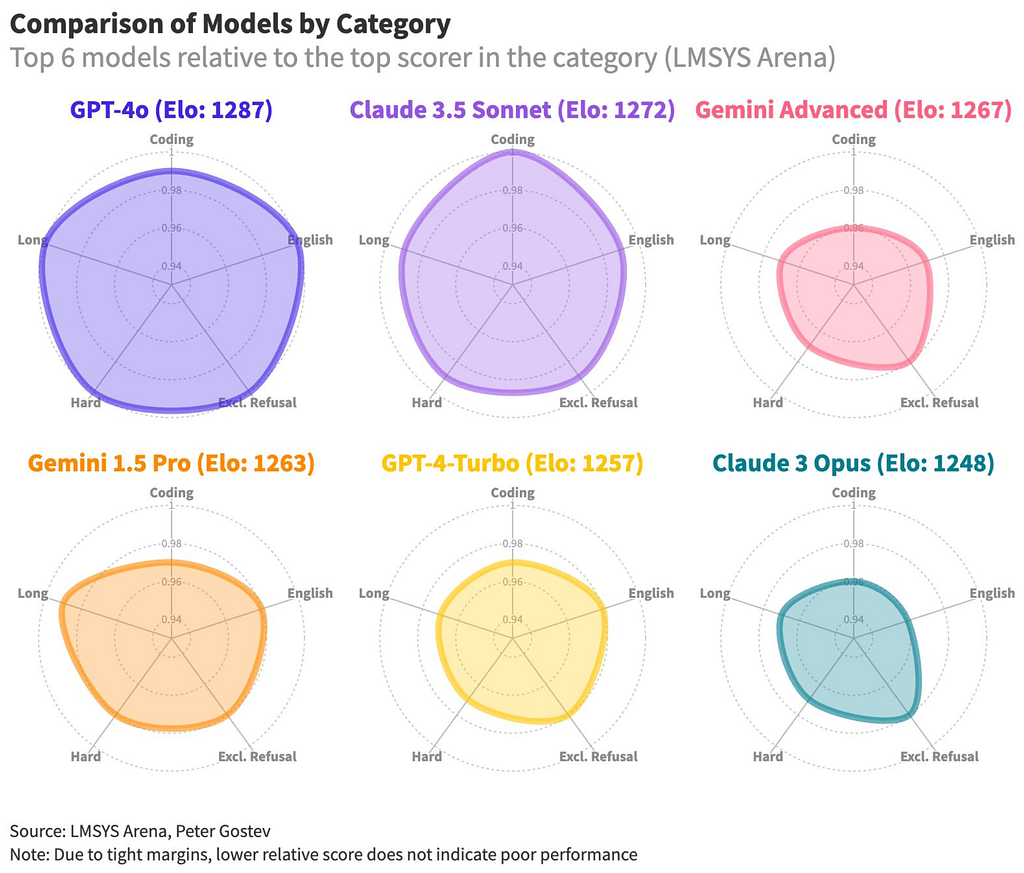
Graph Comparison Across AI Models
This Graph shows that Claude 3.5 Sonnet ability for coding is higher than any of the other models. I would love to see this benchmark with o1 there. While Claude 3.5 Sonnet clearly beats the others, GPT-4o remains better at English.
Let’s Be Fair
Note that I’m not entirely being fair to OpenAI’s GPT-o1 model. Honestly, I have worked with it very little, mostly because I was hitting the rate limits too quickly with the Plus Subscription, which became very frustrating. That said, I don’t have a great first experience nor an unbiased proof that GPT-o1 isn’t a great model. Benchmarks show that o1 is superior in reasoning, though it is slower and more costly, while Claude 3.5 Sonnet is superior in coding tasks. Some other benchmarks suggest that o1 might be better suited for very complex programming and mathematical tasks. It’s up to you — if you’re not working on novel physics or math theorems, I would recommend choosing the tool that helps you get the job done rather than one that leaves you entertained and frustrated, delving into complexity without ever coming out with a solution.
Conclusion
These features make Claude 3.5 Sonnet a powerful and comfortable tool for everyday coding and engineering tasks, potentially enhancing productivity and code quality across various development scenarios. I’m giving it a try for a couple months, to see how my processes improve. I started by cancelling my OpenAI Plus subscription starting from January 15th 2025, which is also scary after almost two years of having started with it!
In summary, Claude 3.5 Sonnet demonstrates significant potential for improving productivity and creativity in coding and engineering workflows. With features like enhanced coding performance, a larger context window, and advanced reasoning capabilities, it offers a compelling alternative to ‘traditional’ tools. As I explore its capabilities further, I’m curious — what tools are you currently using, and are you considering giving Claude a try? What will you miss? I definitely will miss the voice assistant.
References
[1] https://www.anthropic.com/news/claude-3-5-sonnet [2] https://blog.getbind.co/2024/06/21/claude-3-5-sonnet-does-it-outperform-gpt-4o/ [3] https://www.anthropic.com/claude/sonnet [4] https://www.vellum.ai/blog/claude-3-5-sonnet-vs-gpt4o [5] https://community.sap.com/t5/technology-blogs-by-members/anthropic-s-claude-3-5-sonnet-why-everyone-s-talking-about-it/ba-p/13739653 [6] https://www.memfree.me/share/lXNTOIT [7] https://www.qodo.ai/blog/comparison-of-claude-sonnet-3-5-gpt-4o-o1-and-gemini-1-5-pro-for-coding/ [8] https://www.datacamp.com/blog/claude-sonnet-anthropic [9] https://www.youtube.com/watch?v=X58CJykY6vo
Originally published on Medium.